What the employer does and what you do while the visa is arranged. The Code 95 material is here too.
What you will find inside: who does what while the work permit and visa are arranged, what to expect from the employer, and the Code 95 material to read before you arrive.
What the employer does and what you do while the visa is being arranged. This stage starts only once all your documents are reviewed and the employer accepts you.
Important: exact fees, forms and timelines depend on your country and the rules in force at the time — we confirm them individually for every driver. All fees are paid directly to the institutions or the VFS centre. Never pay a “facilitation” fee to any private person.
Code 95 is a mark on your driving licence confirming your professional qualification in Europe. The 140-hour training itself is arranged by your employer in Lithuania, but the topics you will need are the same: road safety, eco-driving, load securing, the tachograph and driving–rest rules, and vehicle maintenance.
Read these two documents before your flight — you will arrive prepared and the training will be far easier.
Code 95 is a special mark on a driver's licence confirming that the driver has completed professional training and may carry goods or passengers commercially under EU requirements. Training duration — 140 hours.
Code 95 is mandatory for drivers who: drive vehicles of categories C1, C, CE, D1, D and DE; carry goods or passengers commercially; work as professional drivers in the EU.
5 years is the standard validity period. After that the driver must complete 35 hours of periodic training (no exam) to renew the qualification.
Driver's responsibility. Drivers are personally responsible for the lives and health of all road users. They must follow traffic rules, stay attentive, anticipate hazards and act to prevent them.
Risk assessment and accident prevention. You must recognise potential hazards: the behaviour of others, road conditions and the technical condition of the vehicle.
Distance, speed, braking. The higher the speed, the greater the distance required. Speed must suit the road conditions and be safe — not merely within the legal limit. Account for braking distance (speed, weight, road conditions). Avoid sudden braking, especially on slippery roads.
Driving in difficult weather. Rain, snow, fog and ice require extra caution: increase distance, reduce speed, use low-beam headlights in fog and precipitation, check wipers, brakes and tyres, and avoid sudden manoeuvres.
Lower fuel consumption. Avoid sharp acceleration and braking — they raise consumption significantly. Hold a steady speed on the motorway. Do not overload the vehicle. Watch tyre pressure: low pressure increases rolling resistance.
Optimal gear shifting. Shift up as early as possible without labouring the engine. Avoid revs that are too low or too high.
Eco-friendly habits. Avoid idling — if parked for more than a minute, switch the engine off. Use engine braking when slowing down: it reduces brake wear and saves fuel. Use momentum.
Securing and distributing the load. The load must be fixed so it does not move under sudden braking, in turns or under sharp acceleration. Spread the weight evenly across the platform, avoid overloading axles, and keep the centre of gravity as low and central as possible.
Dimensions and permitted axle loads. Combination (truck + trailer) 18 m, width 2.55 m, height 4.0 m. Excess axle load destroys the road surface, brings fines and damages the chassis. Under EU directives: single axle 11.5 t, tandem 18 t, triple 24 t, total weight with cargo no more than 40 t.
The tachograph (analogue and digital) records driving time, breaks, rest, speed and distance. The driver must know how to use it, insert their personal card before moving off and make printouts when needed (inspection, malfunction). Both driver and carrier are liable for violations.
Important: liability is not removed if the violation was committed at the employer's request. Tachograph data is checked on the road, at the company and at border control.
Driving and rest rules (Regulation 561/2006). Daily driving up to 9 hours; up to 10 hours no more than twice a week. Weekly no more than 56 hours; no more than 90 hours in two consecutive weeks. After 4 hours 30 minutes of continuous driving — a break of at least 45 minutes (splittable 15 + 30, in that order). Daily rest at least 11 consecutive hours; reducible to 9 hours (max three times between two weekly rests); split rest of 3 + 9 hours is also allowed. Weekly rest at least 45 hours; reduced rest at least 24 hours (no more than every 2 weeks), compensated by the end of the third week. With a two-driver crew, both must get at least 9 uninterrupted hours within 30 hours.
Following 561/2006 means safety, driver health and protection from fines.
Daily checks and identifying faults. Signs of a fault while driving: rough running and unusual noises; the vehicle pulling to one side; rising coolant temperature; leaking fuel, oil or fluids; longer braking distance or squealing; uneven suspension (humming, impacts, roll); warning lamps on the dashboard.
If you notice a fault: stop immediately if safety is at risk, fix it yourself or call technical support, and inform the dispatcher or mechanic.
Driving is prohibited when: brakes or steering are faulty; lights do not work at night or in bad weather; tyres are worn below the permitted tread; the body is damaged and threatens passengers, cargo or driver; fuel or oil is leaking.
Also important: keep to scheduled maintenance per the manufacturer's schedule and watch replacement intervals for oil, filters, brake pads and belts.
A wider explanation — in the Code 95 article.
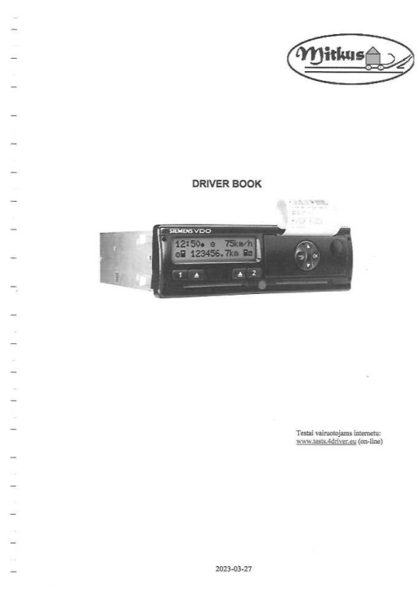 Driver Book — road rules and tachograph (English)PDF · 100 pages · 7.6 MB
The “Driver Book” was produced by the Mitkus driving school. We share it with their permission — for personal preparation only.
Group call with the employer. At this stage a joint call with the employer may be scheduled — a Q&A session about the whole preparation: arrival, welcome and first steps at the company. If everyone’s visa process is going smoothly, the call may not happen at all. Attendance is not required — if you cannot make it, we will send you the recording.